
Welcome to SEND at St Luke's
At St Luke's Primary School, we are committed to ensuring that every child feels valued, included and supported to achieve their full potential. We believe that all children, regardless of their needs, abilities or background, should have access to a broad, balanced and ambitious curriculum and be able to participate fully in school life.
We recognise that children learn in different ways and may need different levels of support at different times in their school journey. Our approach is guided by the Tower Hamlet's Inclusion Framework: , the SEND Code of Practice (2015) and our commitment to inclusive practice.
At St Luke's, we work in partnership with children, families and professionals to identify strengths, remove barriers to learning and ensure that every child has the opportunity to flourish academically, socially and emotionally.
Understanding Our Graduated Approach
At St Luke's Primary School, support for children with Special Educational Needs and Disabilities (SEND) is organised using a graduated approach, in line with the Tower Hamlet's SEND Inclusion Framework. . This approach ensures that every child receives the right support at the right time.
Most children will have their needs met through Wave 1 Universal Support, which includes high-quality teaching, adaptive practice and inclusive classroom strategies available to all pupils.
Some children may benefit from Wave 2 Additional Support, where targeted interventions are delivered in small groups to address specific barriers to learning. Examples at St Luke's include Sensory Circuits, NELI, ELSA, Lego Therapy, Lifeboat Reading and Maths Intervention programmes.
A small number of pupils may require Wave 3 Personalised and Specialist Support. This may involve individualised programmes, specialist assessments, support from external professionals and provision specified within an Education, Health and Care Plan (EHCP).
For more information about the layers of SEND support please view our Provision map:
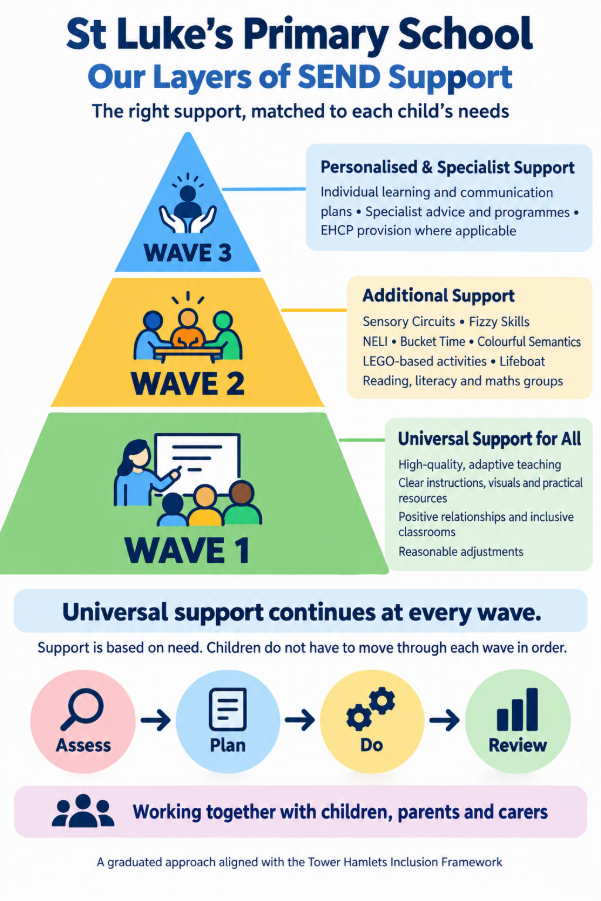
Support is regularly reviewed with pupils, families, teachers and external professionals to ensure that provision remains effective and responsive to each child's needs.
| Level of Support | Communication and Interaction | Cognition and Learning | Social, Emotional and Mental Health | Sensory and Physical |
|---|---|---|---|---|
| Wave 1 - Universal support available to all children in every classroom. | ||||
| Wave 2 - Additional support small group programmes for children requiring extra support. | ||||
| Wave 3 - Personalised and specialist support individualised provision for children with more complex needs. |
Four broad areas of need
| Area of need | |
|---|---|
| Communication and interaction |
Pupils with needs in this area have difficulty communicating with others. They may have difficulty understanding what is being said to them, have trouble expressing themselves, or not understand or use the social rules of communication. Pupils who are on the autism spectrum often have needs that fall in this category. |
| Cognition and learning |
Pupils with learning difficulties usually learn at a slower pace than their peers.
|
| Social, emotional and mental health |
These needs may reflect a wide range of underlying difficulties or disorders. Pupils may have:
These needs can manifest in many ways, for example as challenging, disruptive or disturbing behaviour, or by the pupil becoming withdrawn or isolated. |
| Sensory and/or physical | Pupils with these needs have a disability that hinders them from accessing the educational facilities generally provided.
Pupils may have:
These pupils may need ongoing additional support and equipment to access all the opportunities available to their peers. |
Inclusion at St Luke's
Inclusion is at the heart of everything we do.
We are proud of the work we do to develop an inclusive culture where every child feels they belong. Our staff work closely with families, external agencies and local authority services to ensure pupils with SEND receive the right support at the right time.
Our commitment to inclusion is reflected through:
-
Participation in the Tower Hamlets Inclusive Schools Project
-
Partnership working with the Phoenix Outreach Service
-
Ongoing collaboration with Tower Hamlets SEND services
-
Continued professional development for all staff
-
High expectations for all learners
-
A strong focus on pupil voice and family partnership
What Happens if I Think My Child May Have SEND?
If you have concerns about your child's learning, development or wellbeing, we encourage you to speak to your child's class teacher in the first instance.
Our process is:
-
Talk to your child's class teacher
-
Discuss concerns with the SENDCo if needed
-
Assessment and identification of strengths and needs
-
Additional support planned and implemented
-
Regular review meetings with families
-
Specialist advice sought where appropriate
All support is reviewed using the graduated approach:
Assess → Plan → Do → Review
This ensures that support remains effective and responsive to your child's changing needs.
Useful Information
Tower Hamlets Local Offer
The Tower Hamlets Local Offer provides information about services and support available for children and young people with SEND and their families.
School Documents
- St Luke's Primary School SEND Information Report 2026-2027
- SEND and Inclusion policy
- Accessibility Plan
Working Together
At St Luke's, we know that parents and carers are experts on their children. By working together, we can ensure that every child receives the support they need to thrive, achieve and enjoy school.
We are committed to creating an inclusive environment where every child is respected, celebrated and encouraged to reach their full potential.